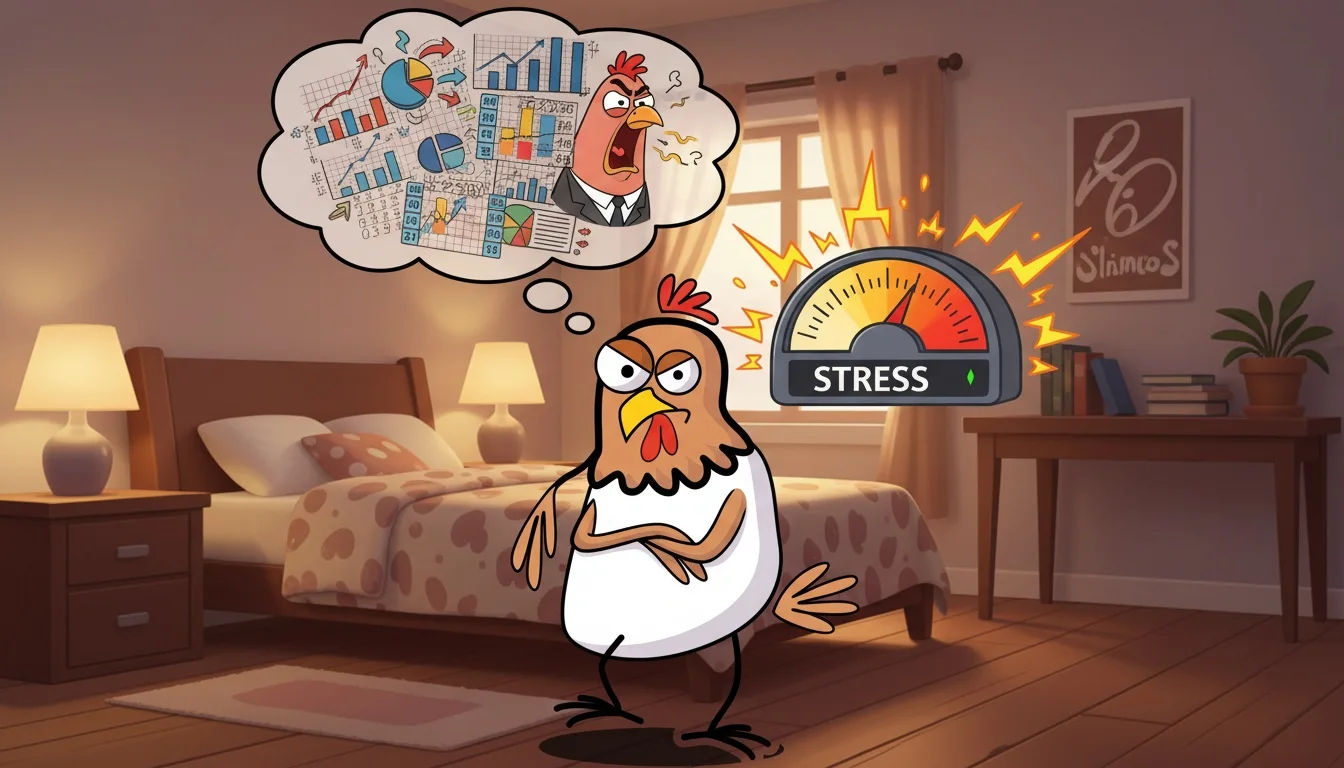
The Stress Belt: Why Cortisol Puts Fat Exactly Where You Don't Want It
The photo that changed everything
Dave noticed it first in a work photo. Someone had snapped the team at one of those 'QBR' dinners and there he was in the middle of the frame, holding a glass of wine he'd barely touched, looking exactly like his father had looked at fifty. WTH??!!
He was thirty-nine. Not even 40 yet, how had this happened?!
The strange part was that nothing else about him had changed. He still ran three times a week, still skipped the second helping at dinner, still counted himself lucky that his metabolism had never given him much trouble. But!... somewhere in the last two years, a soft, stubborn curve had settled in around his middle. Not fat everywhere so he couldn't avoid it...Just there. Front and centre, like it had been placed on purpose.
He mentioned it to his brother-in-law, a physio named Marcus, expecting the usual answer. "Easy fix mate, eat less + Move more + Cut the beer."
Marcus actually asked him a different question instead.
"How's work been bro?"
Dave laughed, because the honest answer took longer than the joke did. Work had been brutal. A promotion 18 months back had come with more money and considerably less sleep. He was up at half five most mornings, phone in hand before his feet hit the floor, running numbers in his head through breakfast etc.. He described himself, half proudly I guess, as someone who was "always switched on." He'd stopped noticing that his jaw ached most evenings from clenching it all day..... Sound familiar yet?
"That's your answer," Marcus said. "Not all of it. But more of it than you think."
The relay race that never ends
What Marcus explained next, over the next few weeks wasn't a miracle fix. It was biology and biology is stubborn, it doesn't care about deadlines!!
He started with the system that starts everything else: the HPA axis, short for hypothalamic-pituitary-adrenal axis. (that's a mouthful isnt it lol). What you need to know is that it's the chain of command that runs the body's stress response.
The hypothalamus, part of the brain senses a threat and sends a signal down to the pituitary gland, which sends its own signal down to the adrenal glands sitting on top of the kidneys. The adrenal glands respond by releasing CORTISOL (the stress hormone) into the bloodstream. It's a relay race, three organs passing a baton and the whole thing is designed to finish quickly.
"In a healthy system, that baton gets passed and then the race is over," Marcus said. "Threat appears, cortisol rises, threat passes, cortisol falls. There's even a normal daily rhythm to it. It's supposed to peak shortly after you wake up, something called the cortisol awakening response, which is basically your body's built-in alarm clock giving you a burst of energy to start the day. Then it's supposed to taper off gradually until evening."
Dave's mornings, Marcus pointed out, was not tapering off anything. Between the phone, the inbox and the mental sprint through the day's numbers before he'd even had coffee, Dave was essentially re-triggering the alarm every twenty minutes! His HPA axis never got the signal to stand down. The result was what an NHS doctor might call 'chronically elevated cortisol', where the hormone stays raised not because of one big crisis but because of a hundred small ones that never fully resolve. (death by 1000 cuts kinda thing).
"That matters for where the fat goes," Marcus said, "because of something called glucocorticoid receptor density." (stick with me here, not as complex as it sounds).
He explained it like this. Cortisol belongs to a class of hormones called glucocorticoids and for a cell to respond to it, that cell needs receptors, essentially docking stations, on its surface or inside it that the hormone can bind to. Fat cells, or adipocytes, all over the body carry some of these receptor!! But the adipocytes packed deep in the abdomen, wrapped around the liver, intestines and other organs in what's called visceral adipose tissue, carry significantly more of them than the fat sitting just under the skin on the arms, thighs or hips, known as subcutaneous fat.
Ok...so in one sentence... stress hormone binds to fat cells...but fat cells around the belly have many more 'docking stations' for them to bind to!
"More receptors means more sensitivity," Marcus said. "So when cortisol is constantly circulating, the visceral depot is the one listening hardest. It's primed to pull in and store fat more efficiently than anywhere else on your body."
Why discipline stops working when cortisol stays high
The second mechanism, Marcus said, was the one that explained why Dave's usual discipline wasn't showing up on the scale, or rather, why it was showing up in the wrong place.
Cortisol doesn't act alone. It has a close working relationship with insulin, the hormone released by the pancreas to manage blood sugar. Under normal conditions, insulin helps cells take in glucose for energy. But chronically elevated cortisol interferes with that process, a state called INSULIN RESISTANCE (you've probably heard of this one) where cells stop responding properly to insulin's signal. The pancreas, sensing that glucose isn't being absorbed efficiently, compensates by producing even more insulin, leading to a condition called hyperinsulinemia.
"And insulin, when there's a lot of it around, is fundamentally a storage hormone," Marcus said. "It suppresses an enzyme called hormone-sensitive lipase, which is what your body normally uses to break fat back down and release it for fuel. So you've got cortisol encouraging fat to move into the visceral depot, and you've got elevated insulin discouraging that same fat from being broken down and used. Two systems, not fighting each other, both pointing the same direction."
"So it's not really about willpower," Dave said, half hoping to be let off the hook entirely.
"It's not not about willpower," Marcus said. "You still have to eat well and move. But you've been trying to out-diet a hormonal feedback loop, and that's a losing fight if the loop itself never gets addressed. You're managing the symptom and leaving the alarm running."
What actually worked
Dave didn't fix it in a weekend. There wasn't a single lever to pull. But he started treating his evenings differently, protecting the hour before bed instead of letting his phone eat it, since poor sleep is itself one of the strongest triggers for next-morning cortisol elevation. He started walking at lunch instead of scrolling through inbox zero he was never going to reach. He started, awkwardly at first, saying no to the meetings that didn't need him.
None of it felt dramatic. The HPA axis doesn't announce its return to baseline the way it announces an alarm. There's no single morning where you wake up and know the loop has finally settled. It's slower and quieter than that, easy to miss unless you're paying attention to more than the mirror.
But six months on, the shirt that had started sitting differently on him began sitting the old way again. Not because he'd found some trick his body had been hiding from him all along, but because he'd finally stopped asking his HPA axis to fire on every twenty-minute cycle of an eighteen-hour day.
The waistline, it turned out, was never really the story. It was just the part of the story you could see.
This is the kind of behaviour change that Tucki was built for. Not another app telling you what to eat, but a system that helps you build the routines that let your body work the way it's supposed to. Small habits, sustained over time, until the feedback loop finally settles. Real life, real food, real change.
Join The Habit newsletter