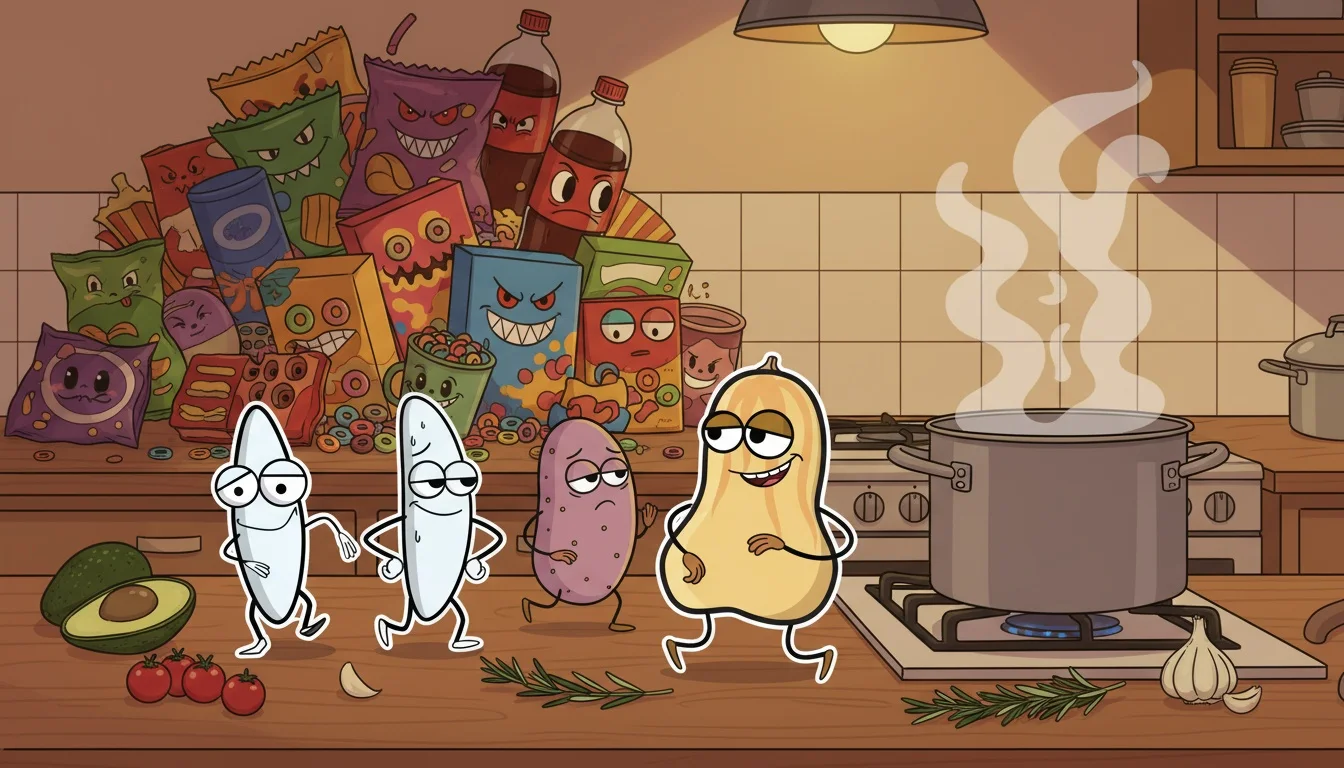
What Is Real Food? A No-Nonsense Guide for Busy Families
You already know what real food is
You don't need another influencer telling you that carrots are better than crisps, do you?! You know that. The confusion isn't about whether broccoli is healthy. It's about where the line sits between a tin of tomatoes and a microwave lasagne and whether you're supposed to feel guilty about fish fingers on a Tuesday night. For the avoidance of doubt, you're not.
So let's cut through the noise. What is 'real' food? It's ingredients you recognise. Stuff your grandparents would call food. Things that grow, rot and don't need a lab to exist.
Now, this is not because of some moral purity test lol, but because your brain and body are designed to run on nutrients, not synthetic molecules engineered for profit margins. Ya get me?
What happened in the late 70s that changed everything
Ultra-processed food has been creeping into our diets since the 1950s, but the real shift happened when corn subsidies in the 1970s deliberately cheapened ingredients for food corporations. UPF now makes up over 60% of the UK diet and obesity rates in children have tripled in 30 years. That's not a coincidence is it? I don't need all the "CoReLaTiOn vs CaUsAtIoN' mob to start pelting me with insults here.
These aren't just convenient shortcuts. UPF is industrially created to override the signals that tell you when to stop eating. Studies show that people consume 500 extra calories per day on ultra-processed diets compared to whole (REAL!) food, even when the nutrients look identical on paper.
Now to be ultra clear: The problem isn't your willpower!! It's that processed foods are often stripped of fibre, omega-3s and the stuff that actually triggers satiety, then 'often' packed with fructose, trans fats and additives that mess with your gut and liver. there it is.
Your brain needs omega-3s, B vitamins and essential minerals to function. It uses 23% of your body's energy at rest and is 60% fat by dry weight. When you swap real food for nutritionally empty substitutes, the impact is measurable. Kids whose mothers drank sugar-sweetened beverages during pregnancy show IQ drops of 1.2 to 1.7 points per additional daily serving (seriously, this is a harsh stat, please don't panic if you did, this can all be sorted). Only 4.5% of UK children meet oily fish targets, meaning most are nutritionally compromised before they even start school (again lol, can all be fixed quite easily).
The Tucki rule: 80/20, not perfection
This is where most advice falls apart. It tells you to avoid processed food entirely, which lasts about three days before someone has a meltdown over a battenburg. Real life is messy. You're tired. The kids are hangry. Sometimes fish fingers happen matey, so bloody what.
BUT - That's why Tucki uses the 80/20 rule. If 80% of what your household eats is real food and 20% is processed, you're doing brilliantly. It's realistic, sustainable and it works. On the app, there's a UPF score that stays green when 20% or less of your logged intake is ultra-processed. No shame, no perfection chasing, it's just a simple lil' visual that helps you notice patterns without turning every meal into a moral crisis (you've gotta knock that on the head if you are btw).
Why 80/20? Because it's enough to reduce inflammation, support your family's brain health and dodge the metabolic chaos that comes from a diet dominated by UPF, while leaving room for the imperfect, exhausted reality of feeding humans every single day.
So what actually counts as real food?
Ingredients. That's it. Chicken, rice, butter, eggs, flour, tomatoes, cheese, oats, lentils, potatoes. Things that exist without a factory. A tin of chickpeas is real food. A ready-made tikka masala with 19 ingredients you can't pronounce is not.
Processed doesn't automatically mean bad. Bread is processed. So is yoghurt! But there's a difference between fermenting milk and injecting emulsifiers into reconstituted protein powder shaped like a yoghurt pot. Again, do ya get me?
The test is simple: could you make it at home if you had the time and the recipe? If yes, it's probably real food. If it requires industrial equipment and a chemistry degree, it's ...probs UPF lol.
Why it matters and how to actually track it
Your body is designed to extract nutrients from real food. Fibre triggers the hormones that tell you when you're full. Omega-3s build your kids' brains. Whole ingredients support your gut, liver and metabolic health in ways that synthetic substitutes just don't.
But knowing that doesn't help if you're staring at the fridge at 6pm with no plan and three hungry people shouting demands.
Tucki helps you close that gap. It's not about logging every gram or chasing some impossible standard. It's about building habits that actually stick. The UPF score gives you a quick visual check without turning dinner into a spreadsheet. You cook more often. You waste less. You notice what's working. And your household eats better without anyone feeling punished.
Real food isn't a rulebook. It's just ingredients, cooked at home more often. That's it...and if you need a bit of help making it happen when life gets overwhelming, that's what we're here for.
Shameless plug: download Tucki today y'all